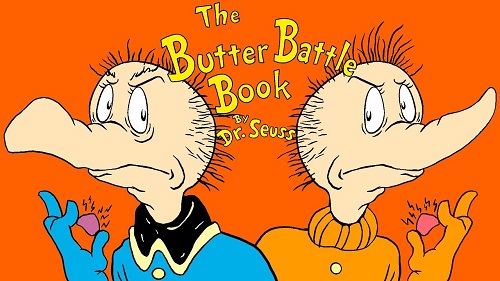
Last Thursday night I read The Butter Battle Book to my granddaughter Ada, age seven. It was the first of three books we shared before bed, and as soon as the Yooks and Zooks began arguing about which side of their bread should face the butter, I felt a familiar bell of mindfulness ring inside me.
This simple children’s story—funny, rhythmic, and absurd—suddenly revealed itself as a perfect illustration of one of the most essential teachings in my Buddhist practice: the danger of becoming attached to views.
The Butter Battle and the Birth of a Conflict
In Dr. Seuss’s story, the Yooks butter their bread butter-side up, while the Zooks insist on butter-side down. That’s it. That’s the whole disagreement. And yet, from this tiny difference, an entire arms race unfolds—each side building bigger, stranger, more dangerous weapons to defend the “correct” way to butter toast.
Reading this with Ada, I could see her eyes widen as the weapons escalated. She kept asking, “But why don’t they just talk?” A very good question. A very Buddhist question.
The Second Mindfulness Training: Non‑Attachment to Views
As a member of the Order of Interbeing since 2008, I’ve recited the Second Mindfulness Training countless times:
“Do not be idolatrous about or bound to any doctrine, theory, or ideology… Even Buddhist ones.”
Thích Nhất Hạnh teaches that suffering begins the moment we cling to a view and declare it to be the only truth. The Yooks and Zooks are perfect examples. Their entire conflict rests on the belief that their way of buttering bread is the right way, the only way, the way worth defending at any cost.
This is how wars begin—internally, interpersonally, and globally.
Seeing the Book Through Ada’s Eyes
Children have a way of cutting through nonsense with startling clarity. Ada didn’t care which side was “correct.” She cared that the characters were hurting each other over something silly.
Her natural response reminded me of Thích Nhất Hạnh’s teaching that peace is always possible in the present moment, but only when we release our grip on rigid ideas. When we soften. When we listen. He also says that Yorks and Zorks are not the enemy. The true enemies are greed, hatred and delusion in their various forms and meanings.
The Yooks and Zooks never pause long enough to ask, “Is this worth it?” or “What fear is driving me?” or “What suffering is the other side experiencing?” They never breathe. They never look deeply.
But Ada did.
Thích Nhất Hạnh’s Wisdom in a Dr. Seuss Story
Thầy often said that the roots of war are in the way we think. When we cling to a view, we create an “us” and a “them.” The moment we divide the world this way, compassion collapses.
In The Butter Battle Book, the absurdity of the conflict is the teaching. Dr. Seuss shows us how quickly small differences can become enormous when we refuse to let go of our certainty.
This is why the Second Mindfulness Training is not abstract philosophy—it is a practical tool for daily life. It reminds us:
- To hold our views lightly
- To listen deeply
- To recognize that our perspective is only one among many
- To avoid turning opinions into weapons
If the Yooks and Zooks had practiced even a single breath of mindfulness, the story would have ended very differently.
A Teaching for All Ages
As Ada refuesed sleep, I found myself grateful for the chance to revisit this book through her fresh eyes. Children’s stories often carry truths that adults forget. And sometimes, a tale about buttered bread becomes a mirror reflecting our own attachments.
The next time I feel myself digging in—defending a position, clinging to a belief, insisting on being right—I hope I remember the Yooks and Zooks, standing on opposite sides of a wall, holding their increasingly ridiculous weapons.
And I hope I remember Ada’s question:
“Why don’t they just talk?”


You must be logged in to post a comment.