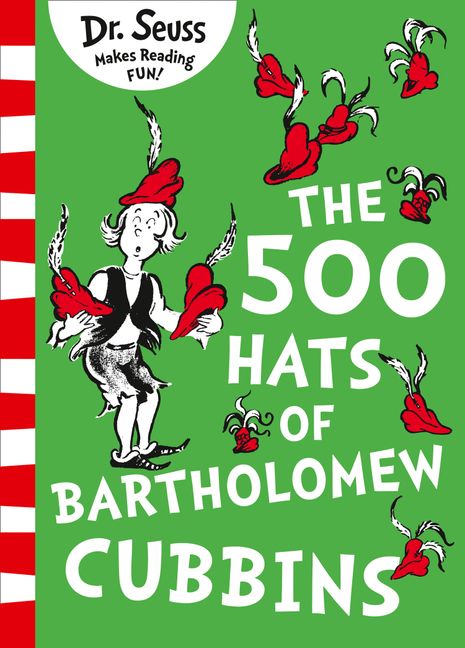
Recently babysitting my granddaughter, after finishing The Butter Battle Book, Ada and I opened another Dr. Seuss classic: The 500 Hats of Bartholomew Cubbins. It’s a story I’ve read many times over the years, but reading it with my seven‑year‑old granddaughter brought a fresh wave of insight — the kind that only arises when a child’s presence helps you see an old teaching with new eyes.
As Bartholomew tries again and again to remove his hat in the presence of the king, only to find another hat instantly appearing in its place, I couldn’t help but see the parallel to the endless stream of thoughts, sensations, and mental formations that arise in our own minds.
And suddenly, the story became a perfect metaphor for the practice of mindfulness.
The Hats as Thoughts: A Mind That Won’t Sit Still
In the story, Bartholomew is simply trying to do the respectful thing: remove his hat. But each time he lifts one away, another appears — fancier, feathered, more elaborate than the last. The king becomes frustrated. Bartholomew becomes frightened. And the hats keep coming.
This is exactly what the mind does.
We sit down to breathe, to be present, to rest in awareness — and suddenly:
- A memory arises
- A worry follows
- A sensation in the body demands attention
- A plan for tomorrow appears
- A judgment about the meditation itself sneaks in
Each “hat” replaces the last. And like Bartholomew, we may feel confused, overwhelmed, or even discouraged.
But the hats are not the problem.
Our relationship to them is.
Thích Nhất Hạnh and the Art of Returning
As a member of the Order of Interbeing since 2008, I’ve learned again and again that mindfulness is not about stopping thoughts. It’s about recognizing them, smiling to them, and gently returning to the present moment.
Thích Nhất Hạnh often taught:
“The mind can be compared to a monkey, always jumping from one branch to another.”
But he also reminded us that awareness is like a lamp — once it is lit, even the monkey becomes visible, gentle, and less frightening.
In The 500 Hats, Bartholomew’s hats only stop appearing when the situation becomes so heightened that something shifts — a moment of clarity, humility, and surrender. In that moment, the final hat appears: simple, quiet, unadorned.
To me, that last hat represents mindfulness itself — the moment when awareness finally arises after the storm of mental activity.
The Last Hat: The Moment Awareness Appears
When Bartholomew finally removes the last hat — the plain, ordinary one — something beautiful happens. The king recognizes its simplicity and worth. The chaos settles. The story softens.
This is what happens in practice.
After the swirl of thoughts, emotions, sensations, and stories, there comes a moment — sometimes brief, sometimes spacious — when the mind rests. When awareness is present. When we see clearly.
Not because we forced the thoughts away.
But because we stayed with the practice long enough for the mind to settle on its own.
Reading With Ada: A Teaching Hidden in a Children’s Tale
As Ada listened, she kept asking, “Why does he keep getting more hats?” And I found myself smiling. Because that question is the beginning of mindfulness — the curiosity that notices what is happening without judgment.
Children are naturally mindful. They see what is there, not what they expect to be there. They don’t assume the hats shouldn’t appear. They simply wonder why they do.
Reading this story with her reminded me that mindfulness is not about eliminating the hats. It’s about seeing them clearly, one by one, until the mind becomes quiet enough for the last hat to appear.
A Story for Practitioners of All Ages
The 500 Hats of Bartholomew Cubbins is more than a whimsical tale. It is a mirror held up to the mind — a reminder that thoughts will arise endlessly, sometimes comically, sometimes inconveniently, sometimes overwhelmingly.
But with patience, compassion, and steady practice, awareness will come.
And when it does, it is as simple and beautiful as Bartholomew’s final hat.


You must be logged in to post a comment.